The National Trial Lawyers
Super Lawyers
500 Leading Plaintiff Financial Lawyers Lawdragon 2026
AVVO
Martindale-Hubbell
PIABA
American Arbitration Association ICDR Panel Member 2025
Top Financial Professionals in the US - Hot List
Justia Lawyer Rating for Adam Julien Gana
Chambers Spotlight 2026

Darrell G. Frazier (Frazier) was recently barred from the securities industry by the Financial Industry Regulatory Authority (FINRA) over allegations that Frazier made fraudulent statements in the sales of variable annuities.  Frazier is also alleged to have made unsuitable variable annuity sale recommendations to customers.

Frazier first became registered with a FINRA member firm in March 1988.  Frazier was registered with Park Avenue Securities LLC from July 2002 through June 2010.  From August 2010 through May 2011, Frazier was associated with MML Investors Services, LLC.

FINRA alleged that from 2004 to at least 2009, Frazier made materially false and misleading statements in connection with recommending customers purchase variable annuity products issued by Guardian Insurance & Annuity Company, Inc.  A variable annuity is a contract where an insurance company agrees to make periodic payments to an investor either immediately or at some future date.  The purchase of a variable annuity contract either involves a single purchase payment or a series of purchase payments.
Avvo is a free website that helps consumers review attorneys and also provides an expert-only question and answer forum where people can ask legal questions. Launched in 2007, Avvo has developed a rating scale for lawyers based upon a proprietary algorithm.  Recently Avvo ranked Adam Gana a “10/10” for his experience, skill, and industry recognition. To view his profile, please visit: http://www.avvo.com/attorneys/10123-ny-adam-gana-1017004.html


Gana Weinstein LLP’s Adam Gana was quoted today in a Reuters article exploring the investing habits of several attorneys who prosecute securities fraud cases against brokerage firms and individuals.  Having seen many investments go sour through unforeseen risks and failure to disclose, the attorneys featured stated that they tended to invest in more traditional investments such as stocks and bonds rather than complex and novel products.  In addition, the attorneys gravitated toward lower costing investments such as individual stocks, bonds, municipal bonds, rather than mutual funds or bond funds that charged high fees.

The full length article can be found at: http://www.reuters.com/article/2013/09/26/lawyers-invest-idUSL2N0HL1JI20130926

September 26, 2013 (New York) – Adam Gana is quoted by Suzanne Barlyn of Reuters in her article entitled “How Lawyers Who Chase Brokers Invest Their Own Money.”


The Financial Industry Regulatory Authority (FINRA) recently released a report detailing the American public’s susceptibility to financial fraud.  The Financial Fraud Research Center estimated that fraud costs the American people over $50 billion a year without including the cost of efforts to prevent and prosecute fraud.

The report entitled, Financial Fraud and Fraud Susceptibility in the United States made two summary claims.  The first claim is that ever present fraud solicitations coupled with the inability of people to recognize the signs of fraud place a large number of Americans at risk, especially older Americans.  Second, policy maker’s inability to obtain an accurate measure of financial fraud frustrates our understanding of its prevalence and our ability to prevent fraud.

The study highlighted that many Americans cannot identify classic “red flags” of fraud.  For instance, the study cited that many Americans lack an understanding of what a reasonable rate of return on a investment would be.  The study found that over 4 in 10 people participating in the study found promises of a annual return of 110% or a “fully guaranteed” investment appealing.  Participants found such promises appealing even though returns of over 100% are highly improbable and virtually no investment is guaranteed.  This lack of understanding leaves many Americans susceptible to fraudulent sales pitches.  The study also found that older Americans, age 65 and older, are more likely to be targeted by fraudsters and 34% more likely to lose money than people in their forties.

Conrad Tambalo Bautista (Bautista) resolved charges brought by the Financial Industry Regulatory Authority (FINRA) concerning the sale of private securities and possible involvement in a fraudulent investment scheme by accepting a bar from the securities industry.

Bautista has been associated with seven FINRA member firms including his most recent employer, CUSO Financial Services, L.P. (CUSO) from January 2010 to March 2013.  Prior to CUSO, Bautista was associated with SWBC Investment Services, LLC, Financial Network Investment Corporation, and Wells Fargo Investments, LLC.  Bautista obtained Series 6, 7, and 63 securities licenses.

Bautista’s public records do not disclose any businesses, other than CUSO, that Bautista was involved in.  However, in February 2013, a customer allegedly filed a complaint against Bautista involving potential securities related misconduct.  Subsequently, FINRA sent Bautista requests for information concerning the substance of the customer complaint.  The FINRA letter sought information into whether Bautista may have engaged in fraudulent investment schemes.  In addition, FINRA had information that suggested that Bautista may have been involved in undisclosed outside business activities and private securities transactions that may have involved borrowing money from customers.

The Financial Industry Regulatory Authority (FINRA), VSR Financial Services, Inc. (“VSR”), and Donald J. Beary (“Beary”) have reached a settlement concerning charges brought by the securities regulator that VSR violated customer concentration guidelines and otherwise failed to reasonably supervise its brokers in the sales of alternative investments.  The settlement led to VSR paying a $550,000 fine and Beary being suspended from associating with a FINRA firm for 45 days and a $10,000 fine.

VSR is based in Overland Park, Kansas, has 211 branch offices, and employs approximately 460 registered personnel.  Beary is a co-founder of VSR and is its executive vice-president, chairman of the board, and direct participation principal.

According to FINRA, from 2005 until 2010 VSR and Beary failed to adequately implement the firm’s supervisory procedures concerning concentration limits in customer accounts for alternative investments.  The settlement details that VSR’s supervisory failures regarding concentration limits occurred because the firm used inaccurate statements reflecting the customer’s true concentration in alternative investments and because the firm used inaccurate risk ratings of products to increase allowable concentration levels.

Jonathan G. Sorensen (Sorensen) has been barred by the Financial Industry Regulatory Authority (FINRA) after he failed to respond to the agency’s inquiries concerning an investigation concerning the possible misuse of customer funds in his management of limited partnership investment fund.

Sorensen first became registered with FINRA on September 9, 2005.  Since that time he was registered until April 4, 2013, with Coker & Palmer, Inc. (Coker & Palmer).  According to public records, Sorensen is also a managing member of Higher Standard Insurance and Faith Terrace Holdings, LLC, a purported real estate company.

On April 5, 2013, FINRA staff requested that Sorensen appear for an interview on April 12, 2013.  The agency sought information from Sorensen as part of an investigation into his management of a limited partnership investment fund while associated with Coker & Palmer.  It was alleged that Sorensen had converted or misused investor funds and falsified documents in connection with his management of the partnership fund.

p344456Every year, companies across the United States raise hundreds of billions of dollars selling securities in non-public offerings that are exempt from registration under the federal securities laws. These offerings, known as private placements, can be a tremendous source of capital for both small and large business. However, according to FINRA, investors should be aware that private placements can be illiquid and are very risky with the potential to lose most or all of your investment.

Fraud and Sales Practices Abuses

For over three years, FINRA has been investigating private placements and has uncovered fraud and sales practice abuses related to private placements that resulted in sanctions of individual brokers and financial institutions for providing investors inaccurate information relating to private placements. In addition, some materials omitted information necessary for investors to make informed investment decisions. Finally some firms failed to conduct adequate investigations into whether the private placements were suitable for customers.

In July 2013, William Galvin, the Massachusetts (MA) Secretary of the Commonwealth, began an investigation into “the marketing of complicated financial investments to older people.” In the process of the investigation, Galvin subpoenaed fifteen different brokerage firms in order to obtain information on investments that were sold to senior citizens in Massachusetts. The investigation sought to uncover the way the firms have sold “high-risk, esoteric products to seniors” as well as information on the firms’ compliance, supervision and training.

The firms that were included in the investigation were Morgan Stanley, LPL Financial, Merrill Lynch, UBS AG, Bank of America Corp., Fidelity Investments, Wells Fargo and Co., Charles Schwab Corp., and TD Ameritrade along with other firms. Galvin has stated that the investigation was not an indication of any wrongdoing on behalf of the brokerage firms. The purpose of the investigation was to get more information on brokers’ business practices in offering products to seniors and unsophisticated investors. Regulators have shown concern about “opaque products” advertised to unsophisticated investors looking for higher returns than what most interest rates have to offer.  Brokers often pitch these types of products because they will usually get a higher commission rate than by selling other lower risk products such as mutual funds.

This recent investigation is a result of past inappropriate Real Estate Investment Trust (REIT) sales to seniors.  Last year, the SEC probed the probe improper sale of REITs to seniors that led to five broker-dealers settling.  The settlement for the improper REIT sales included $975,000 in fines and $8.6 million in restitution to the customers.

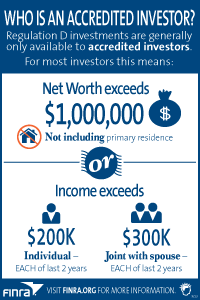
In a 4-1 vote, the Securities Exchange Commission (SEC)  approved a rule that would now allow broker-dealers, hedge funds, and private equity firms to advertise to the general public for private placement securities offerings.  Firms are still limited to sales to accredited investors. Accredited investors are defined as those who have a net worth of $1 million, excluding the value of the investors primary residence, or earning at least $200,000 annually. According to Investment News, there are 9 million homes in the United States that meet this standard.

The SEC’s new rule will require that private-placement issuers take reasonable and appropriate steps to assess an investor’s qualifications and ability to meet the accredited investor standard. According to the SEC, the broker may have to independently verify that the client meets the appropriate standards.

The new rule will give funds the ability to publicly solicit private investments. The SEC’s rule is an implementation of the Jumpstart Our Business Startups Act enacted by Congress in April 2012. Will the law help entrepreneurs raise capital or will investors lose another level of protection? Only time will tell.

Contact Information