
Articles Posted in Private Placements

In August, I wrote an article about how the brokerage firm Advanced Equities, Inc. (Advanced Equities) and First Allied Securities, Inc. (First Allied) sold nearly $1 billion in private placement offerings linked to clean technologies (clean-tech) to investors that have since become nearly worthless.   Some of those investors have now come forward alleging that the brokerage firms did not conduct proper due diligence for selling the private placements.  The private placements sold by the two brokerage firms include Advanced Equities GreenTech Investments, LLC, AEI 2007 Venture Investments, LLC, AEI 2010 Cleantech Venture, LLC, and AEI Fisker Investments, LLC.

One of the most prominent underlying investments in Advanced Equities private placement offerings portfolio was Fisker Automotive, Inc. (Fisker Auto).  How Fisker Auto was sold to investors offers an unflattering view into how some in the brokerage industry still peddle worthless and speculative securities to unsuspecting investors to enrich themselves at investor’s expense.

Fisker Auto spent over a billion dollars, much of it from investors and a government loan, to invest and develop its cars.  Ultimately Fisker Auto delivered only 2,000 cars and is on the verge of bankruptcy.  Recently, the U.S. Department of Energy (DOE) started an auction on its loan made to Fisker Auto back in 2010.  The DOE is still owed $168 million under the loan terms but put the loan on the auction block after “exhausting any realistic possibility” that Fisker Auto could repay the loan.  The question is how did Fisker Auto receive $1 billion in the first place?
FINRA has barred broker Daniel P. Deighan (Deighan) for seven months and fined him $27,500 over allegations that he recommended private placements to customers that were not suitable given the customers’ net worth, annual income, and the concentration of the private placements in their accounts.

Private placements are securities that do not trade on stock exchanges and are exempt from the regular filing requirements.  Private placements are issued under Regulation D under the Securities Act of 1933.  Regulation D contains three rules (Rules 504, 505, and 506) that provide the rules required to be followed in order to qualify for the exemptions from the more rigorous Securities and Exchange Commission (SEC) registration requirements.

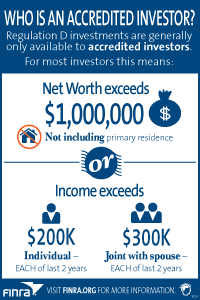
The three rules primarily govern the size of the offering and the number of participants that can invest in the private placement.  However, under all three rules, with certain limited exceptions, investors must meet the “accredited investor” standard under Rule 501. Rule 501 defines “accredited investor” as any person who has a net worth in excess of $1,000,000, (excluding residence) or annual income in excess of $200,000 (or $300,000 jointly with a spouse) in the two most recent years.  While the size of the private placement market is unknown, according to 2008 estimates, companies issued approximately $609 billion of securities through Regulation D offerings.

On September 30, 2013, FINRA filed an amended complaint against John Carris Investments LLC (JCI), its founder George Carris and others. In the complaint, FINRA alleges JCI engaged in: stock manipulation, unsuitable self-offerings of securities, operating a securities business without sufficient net capital, use of firm funds to pay the expenses of principal officers at JCI, providing false tax documents, and failing to pay payroll taxes.

JCI is a Wall Street Investment Bank and wholly-owned subsidiary of Invictus Capital, Inc. (Invictus).  In 2009, Carris formed JCI.  Carris has served as JCI’s CEO, President, and Managing Director of Investment Banking since its inception.  Shortly after forming JCI, Carris formed Invictus and transferred complete ownership of JCI to Invictus.

FINRA alleges that from May 1, 2010 through September 30, 2010, JCI’s head trader Jason Barter engaged in manipulative trading of Fibrocell Science, Inc. (Fibrocell), a biotechnology company specializing in skin and tissue rejuvenation.  During that period, JCI acted as a placement agent for Fibrocell and sold shares of Fibrocell through unregistered PIPE deals.  A PIPE deal is a private investment in public equity, which companies pursue when capital markets cannot provide financing and traditional alternatives do not exist for that issuer.

Conrad Tambalo Bautista (Bautista) resolved charges brought by the Financial Industry Regulatory Authority (FINRA) concerning the sale of private securities and possible involvement in a fraudulent investment scheme by accepting a bar from the securities industry.

Bautista has been associated with seven FINRA member firms including his most recent employer, CUSO Financial Services, L.P. (CUSO) from January 2010 to March 2013.  Prior to CUSO, Bautista was associated with SWBC Investment Services, LLC, Financial Network Investment Corporation, and Wells Fargo Investments, LLC.  Bautista obtained Series 6, 7, and 63 securities licenses.

Bautista’s public records do not disclose any businesses, other than CUSO, that Bautista was involved in.  However, in February 2013, a customer allegedly filed a complaint against Bautista involving potential securities related misconduct.  Subsequently, FINRA sent Bautista requests for information concerning the substance of the customer complaint.  The FINRA letter sought information into whether Bautista may have engaged in fraudulent investment schemes.  In addition, FINRA had information that suggested that Bautista may have been involved in undisclosed outside business activities and private securities transactions that may have involved borrowing money from customers.

The Financial Industry Regulatory Authority (FINRA), VSR Financial Services, Inc. (“VSR”), and Donald J. Beary (“Beary”) have reached a settlement concerning charges brought by the securities regulator that VSR violated customer concentration guidelines and otherwise failed to reasonably supervise its brokers in the sales of alternative investments.  The settlement led to VSR paying a $550,000 fine and Beary being suspended from associating with a FINRA firm for 45 days and a $10,000 fine.

VSR is based in Overland Park, Kansas, has 211 branch offices, and employs approximately 460 registered personnel.  Beary is a co-founder of VSR and is its executive vice-president, chairman of the board, and direct participation principal.

According to FINRA, from 2005 until 2010 VSR and Beary failed to adequately implement the firm’s supervisory procedures concerning concentration limits in customer accounts for alternative investments.  The settlement details that VSR’s supervisory failures regarding concentration limits occurred because the firm used inaccurate statements reflecting the customer’s true concentration in alternative investments and because the firm used inaccurate risk ratings of products to increase allowable concentration levels.

p344456Every year, companies across the United States raise hundreds of billions of dollars selling securities in non-public offerings that are exempt from registration under the federal securities laws. These offerings, known as private placements, can be a tremendous source of capital for both small and large business. However, according to FINRA, investors should be aware that private placements can be illiquid and are very risky with the potential to lose most or all of your investment.

Fraud and Sales Practices Abuses

For over three years, FINRA has been investigating private placements and has uncovered fraud and sales practice abuses related to private placements that resulted in sanctions of individual brokers and financial institutions for providing investors inaccurate information relating to private placements. In addition, some materials omitted information necessary for investors to make informed investment decisions. Finally some firms failed to conduct adequate investigations into whether the private placements were suitable for customers.

In a 4-1 vote, the Securities Exchange Commission (SEC)  approved a rule that would now allow broker-dealers, hedge funds, and private equity firms to advertise to the general public for private placement securities offerings.  Firms are still limited to sales to accredited investors. Accredited investors are defined as those who have a net worth of $1 million, excluding the value of the investors primary residence, or earning at least $200,000 annually. According to Investment News, there are 9 million homes in the United States that meet this standard.

The SEC’s new rule will require that private-placement issuers take reasonable and appropriate steps to assess an investor’s qualifications and ability to meet the accredited investor standard. According to the SEC, the broker may have to independently verify that the client meets the appropriate standards.

The new rule will give funds the ability to publicly solicit private investments. The SEC’s rule is an implementation of the Jumpstart Our Business Startups Act enacted by Congress in April 2012. Will the law help entrepreneurs raise capital or will investors lose another level of protection? Only time will tell.

The Financial Industry Regulatory Authority (FINRA) has barred Ralph Saviano (Saviano) from the securities industry after the broker failed to respond to FINRA’s requests for information and an interview concerning unreported tax liens, a civil judgment, and a customer complaint involving the misuse of funds.

During a routine investigation of Centaurus, FINRA discovered information regarding certain undisclosed liens, judgments, and possible customer loans.  Thereafter, in June 2012, Centaurus filed a regulatory tip disclosing that a customer had provided Saviano with a cashier’s check for approximately $66,000 that was made payable to Saviano.  Saviano’s transactions with the customer concerned a possible misuse or conversion of funds.

Saviano has been associated with several brokerage firms in the past decade.  Until 2004 Saviano was a registered representative of Royal Alliance Associates, Inc.  From April 2004 until December 2006, Saviano was associated with USAllianz Securities, Inc.  Thereafter, from December 2006 until July 2007, Saviano was a registered representative of Questar Capital Corporation.  Finally, Saviano was registered with Centaurus Financial, Inc. (Centaurus) until his termination in June 2012.  According to Saviano’s FINRA disclosure records he is also the president of Saviano Financial Group.

Private securities offerings of oil and gas ventures pose a substantial danger for investor fraud. According to the Securities and Exchange Commission (SEC), there has been an increase in the number of civil fraud cases related to oil and gas private placements.  Investing in private placement offerings carries unique risks and private oil and gas offerings have additional risks for investors to be aware of and to consider.

The SEC’s Investor Alert listed common red flag sales pitches that fraudulent oil and gas investments often make to investors including:

  •  Sales pitches referring to high oil and gas prices;

HKC Securities, Inc., known as ACGM, Inc. (ACGM), and Harold Kenneth Cohen (Cohen) of Palm Beach, Florida, reached a settlement the Financial Industry Regulatory Authority (FINRA) over the firm’s use of certain hedge fund sales material that allegedly failed to fairly present the risks and potential disadvantages of hedge fund investing.  According to FINRA, the sales materials violated FINRA Rule 2210(d) by only highlighting the hedge fund’s positive features, not providing a sound basis for evaluating the investment, containing exaggerated language, failing to identify the basis for factual statements made, and containing an inadequate discussion of the performance of the funds.

The settlement states that between January 2008 and June 2011, the firm marketed hedge funds to large institutional investors such as educational and other endowment funds. The regulator found that ACGM’s procedures for the review and approval of hedge fund institutional sales material were not reasonably designed or implemented to achieve compliance with FINRA’s content standards for institutional sales material and were not appropriate for a business actively engaged in the third-party marketing of hedge funds.  Cohen was the firm’s Chief Compliance Officer and the principal responsible for the review and approval of institutional sales material.  The complaint alleges that Cohen failed to adequately supervise the review of sales materials in order to achieve compliance with FINRA’s content standards.

The settlement provided some examples of the alleged misleading and exaggerated content provided to investors.  One example referred to a fund as having “significantly outperformed its benchmarks” or a fund’s performance as “remarkable.”  Another summary document referred to the performance of the underlying fund managers for a fund of funds over 1-year, 3-year, and 5- year time horizons, even though the fund of funds had only been in operation for approximately three months at the time of the document.  Other documents failed to identify the basis for factual statements made and only described the fund as the “#l hedge fund in Israel” and describing another fund as the “#l performing equity market neutral fund in the world in 2005.”

Contact Information